Plants with calming, exhilarating, or intoxicating scents that will grow in the San Antonio – Austin south central Texas region
Roses (classic damask scented)
While some modern rose varieties are fairly easy to grow, they’re pretty much devoid of odor. Some of the Hybrid Tea Roses have the classic damask scent. Other hybrids have citrus, clove, etc notes. I started with Oklahoma, Chrysler Imperial, Perfume Delight, Fragrant Cloud, Mr Lincoln, Don Juan (climber), Belinda’s Dream. I also had Tiffany, Double Delight, Firefighter. The hybrid teas have about 5 bloom cycles a year here. I can go out and smell some real roses maybe 60 days out of the year. Our winters are mostly mild, and some plants are still in bloom in early January. Eventually I tried Antique or Old Roses: Rose de Rescht, Autumn Damask, Gertrude Jekyll. They are a great addition. The first two seem primordial, the small young buds look more like a vine than a shrub. The hybrid teas look like giant monsters in comparison. The aroma is great; simple, clean, uncomplicated damask. They have fewer bloom cycles per year than the hybrid teas.
I don’t get aphids, even though they congregate on nearby plants such as milkweed. But blackspot and thrips are ever-present, especially in wet years. Alas, thornless roses with damask fragrance are not in existence. The available good growing area on my small lot is shrinking. As my 12 year old live oak trees get bigger, more of the yard receives insufficient sunlight. The west side of the house gets full afternoon sun & 100 deg heat until 8 pm in summer. And it’s dry most years. Not suitable for roses. I’m down to 10 or so roses now; half are in pots, half are in the ground (native clay soil).
I became fascinated with rose scent at age 28 while vacationing in Tampa I happened upon their full city block sized Rose Garden one evening in late December walking back from a brief visit to a bar. The weather was cool and misty and I was subconsciously drawn toward that block. The pleasant aroma became evident as I got closer. Many of the bushes were 4 feet tall or more & it wasn’t necessary to stoop over to sniff them. I later visited rose gardens in other cities and none came close to Tampa’s in late 1982 for olfactory enjoyment.
======================================================================
Almond verbena (Aloysia virgata)
Pleasant almond or cherry scent, some might consider it sickly sweet if up close 24/7. Trouble-free, will survive without supplemental watering for a while even in mid-summer. Good cold tolerance, but when temps stay below 10 F, the trunks might need to be cut back to the ground. There’s a big specimen at the S.A. Botanical Garden that bounced back after our severe freeze Feb 2021. The caretakers know what they’re doing; they watched and waited over 2 months before deciding to cut the 5 trunks back to the ground (see photos in link below). In non-drought years they’re in bloom approx 180 days a year, and multitudes of bees & butterflies are peacefully gorging themselves. The pleasant scent ‘wafts’ about 10 feet. At that distance the aroma is pretty dilute and subtle..
Benzaldehyde is the main chemical contributing to the overall odor. Benzaldehyde is the simplest (smallest & most basic) aromatic aldehyde. It’s structurally related to cinnamaldehyde (cinnamon odor) and phenylacetaldehyde (hyacinth odor). Benzaldehyde is the biggest aroma component by far in extracts from Dr. Pepper soda, in the original Hi-C and other punch flavored drinks, and in cherry flavored drinks.
https://danharring54.blogspot.com/2022/01/freeze-recovery-at-san-antonio.html Freeze recovery at the Botanical Garden 2021 photo gallery
====================================================================
Sweet tea olive (osmanthus fragrans)
I can’t say enough. First, it blooms in winter for several months, when not much else has fragrance. Second, the aroma is unique and very fine, and it ‘wafts’ a nice distance. Visually the plant is rather plain, and the flowers tiny. It’s been trouble free for 8 years, and the 20 gallon pot doesn’t require daily watering during the hot months. I keep it out of full sun. It can handle our winters without problem and doesn’t need to be moved to the garage during periodic cold snaps. However, when it gets much below 32 F the current blooms are killed and the fragrance is gone for a few weeks. So now I move it into the garage nevertheless. During those couple days, the garage smells wonderful (the scent is concentrated in a confined space rather than allowed to diffuse outward). When it’s safe to move back out, the flowers aren’t diminished a bit. At 82 lbs, it’s the heaviest of all my potted plants, but it’s worth the effort to extend its season. In 2023 it first bloomed briefly in late October. In 2025 the aroma became noticeable Nov 2, a few days after our first cold front came through. Some years the aroma is still there in March and early April.
I’ve seen 2 other specimens in San Antonio, both are bigger and older and planted in-ground. The Botanical Garden has one on the south end of their Sensory Garden, overlooking the new entrance. Fanick’s Nursery has one nestled between the 1st and 2nd greenhouse north of the shop. I rarely visit those places in winter, so can’t confirm they actually are odor-producing. I purchased a second plant of the Fudingzhu variety, but it languished a few years in a pot then died. I think I can find the space & time to try another one to put on the other side of the house. The chemicals producing the odor are ionone isomers, which I previously encountered from orris root. It’s extremely pleasant, and is so strong it interacts with incoming fragrances from passing external sources. Some violets also have this aroma.
===================================================
Texas Mountain Laurel (Sophora secundiflora)
I would grow this if I had a bigger yard. It’s one of the first trees to bloom in late winter. Nice color when in full bloom (for about a month). Unremarkable appearance the other 11 months. For most trees here, the scent doesn’t really ‘waft’ down the street much; I have to pass within a few feet to notice it.
The aroma is usually described as grape (grape soda, gum, Kool-Aid, Welch’s purple grape jelly), specifically Concord grape. Regular grapes (Vitis vinifera) are practically odorless compared to Concord grapes (Vitis labrusca). Some citrus trees briefly have this methyl anthranilate odor in early spring. The big box store garden sections usually have a dozen or more specimens in stock at that time of year, and every spring I get a whiff of this aroma from the handful of blooms on the small skinny young trees. Methyl anthranilate a primary amine, which tells me it’s more aggressive or reactive than many of the other amines that contribute to plant scents, which are tertiary amines or secondary amines. Besides methyl anthranilate, ethyl and dimethyl anthranilate are also naturally-occurring in select plant scents. Tangerine peel oil has noticeable dimethyl anthranilate (and it’s a nice contrast to all the monoterpenes and mundane aliphatic carbonyls).
Chemical exam by GC-MS: Methyl anthranilate and ethyl benzoate are the main odorants. I was familiar with these 2 odors from previous unrelated lab analysis, and I perceived the ethyl benzoate as the dominant note coming from the blooms (more so than grape note). Actually I thought it was methyl (not ethyl) benzoate, because methyl was the only pure test material we had on hand. So it was interesting to see the exact components after a GC-MS exam. I later obtained a small vial of some authentic ethyl benzoate test material for use as a chemical reference standard; I seem to recall the aroma of the ethyl was softer and less sharp than the methyl (not unlike the big difference between ethyl and methyl alcohol).
A side note – Methyl benzoate is also used to train cocaine-sniffing dogs, because it’s a characteristic trace volatile breakdown product present at low levels in cocaine (which itself is odorless & non-volatile, i.e. it can’t be evaporated or boiled off without decomposition). It is a very pleasant odor – except when it’s associated with, or a trigger for, binges in susceptible people, (e.g. well there goes another hundred dollars down the drain!). I used to smell it every day when I lived in medium-low rent apartments near downtown. The tweaking ‘rockheads’ hustling down the sidewalk literally exuded it from their breath and clothes. (And they had calluses on their thumbs from using Bic lighters so much.) As if to throw gas on the fire, there was a popular perfume at the time (~1990) that mimicked it. Depending on an individual’s learned associations or bad habits, some pleasant odors can potentially become troublesome triggers.
======================================================================
Oriental lily
Some have an intoxicating scent. However, one family member associates the smell with funerals and dislikes the odor. They bloom later in the growing season compared to Asian lilies. Flowering during the hottest part of the summer is not a good thing in our extremes (e.g. by then the plant is fried and the petals only last a day or 2). My small potted plant with about 7 bulbs did not bloom at all last summer. I’m going to redouble my efforts, protect them from hard freezes and full summer sun, purchase some new bulbs. They’re the only type of lily with such a powerful odor. Some of the small rain lilies have a subtle pleasant aroma, but it’s not noticeable until you’re on hand and knees down at their level and within a couple inches. Here’s a succinct summary from a good gardening website:

======================================================================
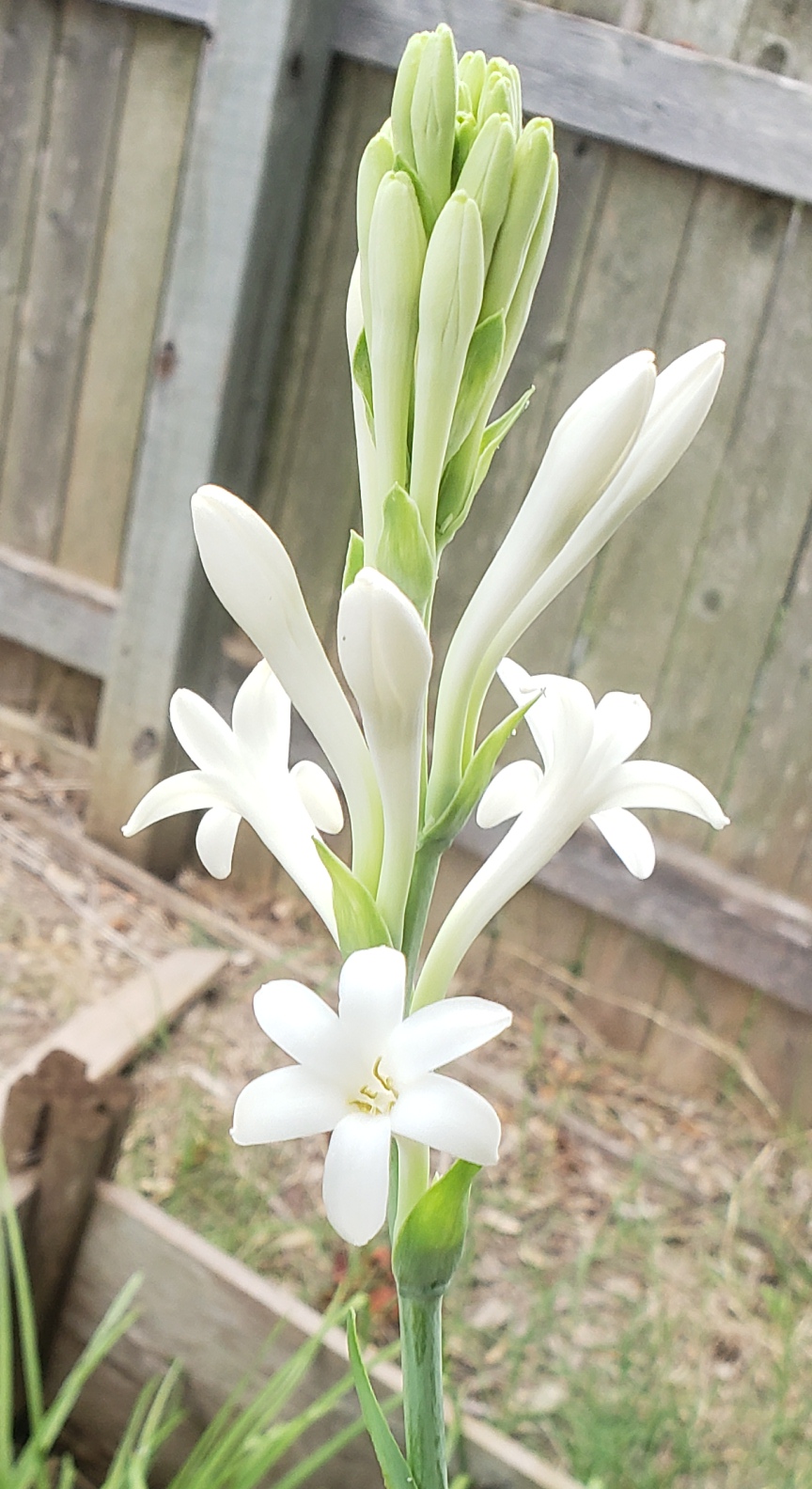
Tuberose (Polianthes tuberosa)
No botanical relation to rose. Exotic intriguing aroma, once called the harlot of perfumery. The scent can ‘waft’ a full 30 feet; not as far as Sweet tea olive, but more than most. When the stalk comes into bloom, each of the dozen or more thick waxy flowers opens successively days apart, and it emits the fragrance for several weeks. My first bulbs came from Burpee, then got more from Tennessee Tuberose. It has a slightly medicinal off-putting camphorous note (reminiscent of Vick’s Vaporub and various Tiger Balms, which seems out of place in typical pleasant floral scents – it both pulls and pushes). It’s easy to grow here, but not all of them have bloomed every year. It’s native to Central Mexico (not so far south of here). I had one stalk come into bloom for several weeks in November this year (2025), with 2 more at the end of December, before we got our first hard freeze. Depending on whether it’s day or night, and during the warm steamy season or a cool dry month, the aroma is always intense but has a different character. When half a dozen are in full bloom during warm humid days a few hours after sunset, it is overwhelmingly pleasant.
====================================================
Star Jasmine (Trachelospermum jasminoides)
Trouble-free evergreen climbing vine with a mildly pleasant odor that ‘wafts’ several feet, especially in plants that had room to spread out and get large. It isn’t a true jasmine (Jasminum genus) but has a similar appearance. The first huge one I noticed is on N. St Marys St on the tall fence/wall to the right of the drive-thru lane at the original Burger Boy. Our State Ag expert Neil Sperry has sung its praises many times over the years in his column.
====================================================
Petunias, dark blue/purple
Jasmine
Just started this year: Winter daphne, Olaeaginous, Moonflower.
Didn’t work out: Pink Jasmine, nicotiana
Abandoned: Heliotrope (baby powder), gardenias, butterfly ginger
Languishing in a pot (so it won’t spread) – Japanese honeysuckle
Worth the effort? daffodil, bulbs, Hyacinths
Indoor plants: certain cyclamens give a nice aroma in winter. Whenever Lowes or Home Depot have several varieties and colors in stock, I sniff them to find the ‘keepers’.
Nuisance. obnoxious or sickly sweet (highly subjective) – huisache trees, night blooming jessamine (reminded me of Brylceem hair cream inflicted on young males in the early 1960s)
Plants with too much indole: gardenia, Arabian jasmine (sambac), butterfly ginger (but tolerable levels are in jasmine)
 Dan Harring (54)