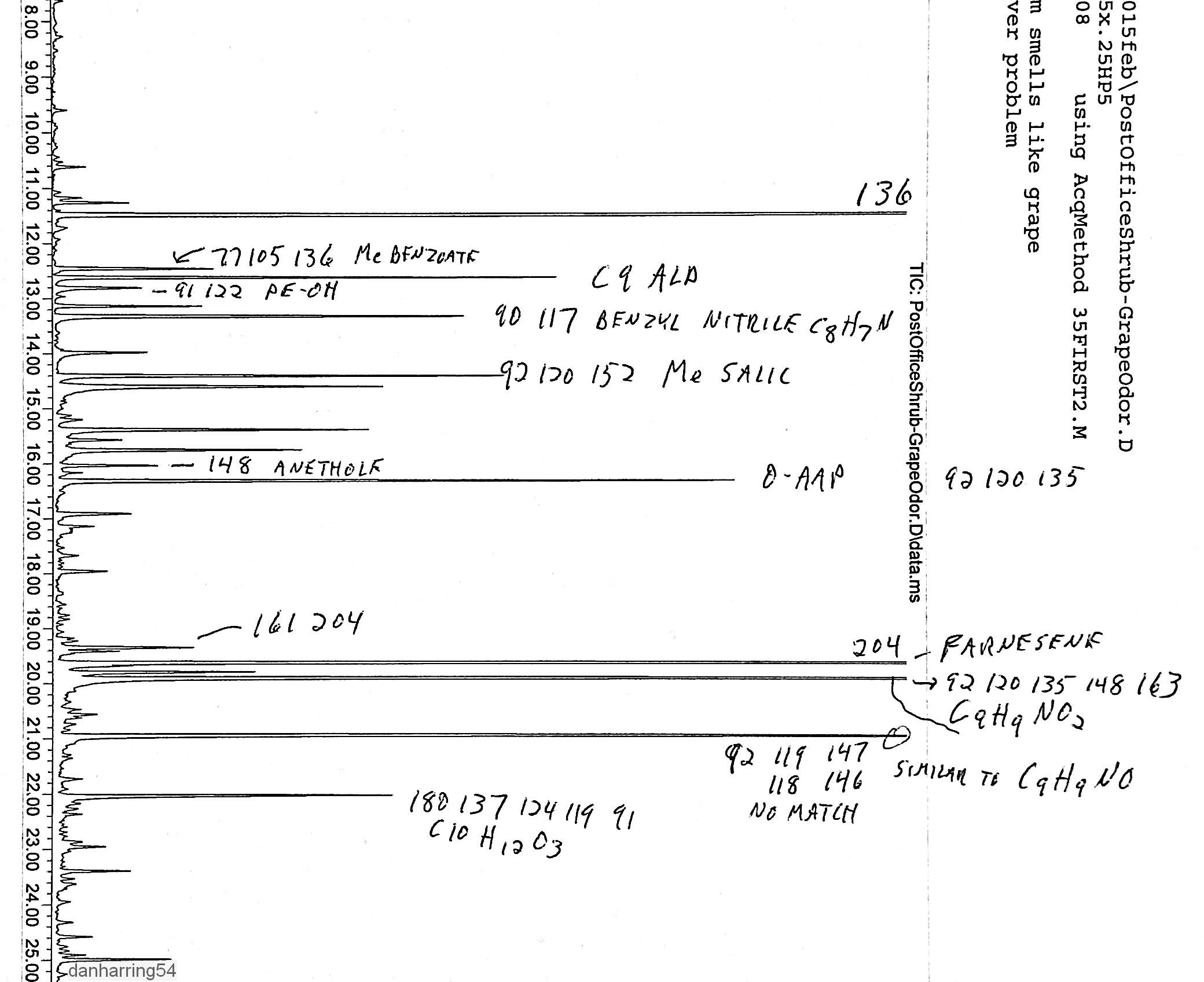
I walked right past this shrub twice a month on my way to the Post Office near my workplace. After 20 years, once in late February I stopped in my tracks when I noticed a pleasant Concord grape aroma for the first time. I collected some flowers for chemical analysis. They were extracted in solvent and analyzed with GC-MS. The Concord grape scent came from ortho-aminoacetophenone. There was only a trace of methyl anthranilate. Here are the most interesting components of the aroma (preceded by their molecular weight, as given by the mass spectrometer):
- 136 Methyl benzoate (Texas Mountain Laurel odor)
- 142 C9 ald = Nonane aldehyde (minor contribution)
- 122 PE-OH = Phenyl ethyl alcohol (rose odor)
- 117 Benzyl nitrile (almond odor)
- 152 Methyl salicylate (wintergreen odor)
- 148 Anethole (anise odor)
- 135 o-AAP = Ortho-aminoacetophenone (grape odor)
It must be an uncommon variety, because regular boxwood doesn’t give this grape aroma. I posted photos on Gardenweb to ask about the fragrance, and if it really was a boxwood. There were 2 affirmative responses from someone who had one in their yard or else heard about it from others.
https://www.houzz.com/discussions/5106228/shrub-id-looks-like-boxwood-with-grape-scented-flowers
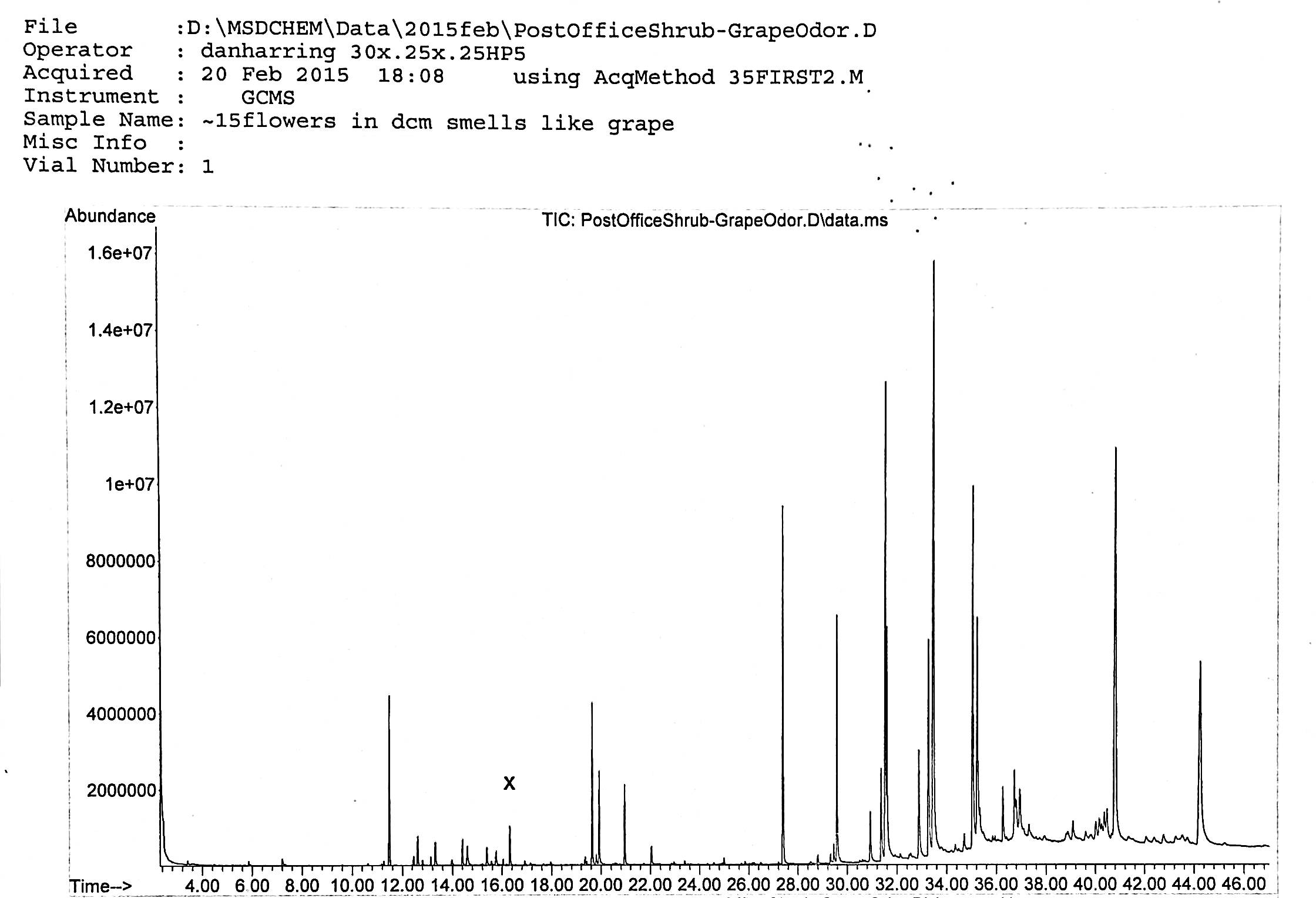
More GC-MS printouts – The full chromatogram, from 3 – 46 minutes. The X above the peak at 16.3 minutes marks where o-aminoacetophenone elutes; it’s not the tallest peak but it’s the predominating odor. The lightest most volatile & ethereal components start on the left. The spikes/peaks on the right half beginning ~27 minutes are odorless natural waxes with higher molecular weights.
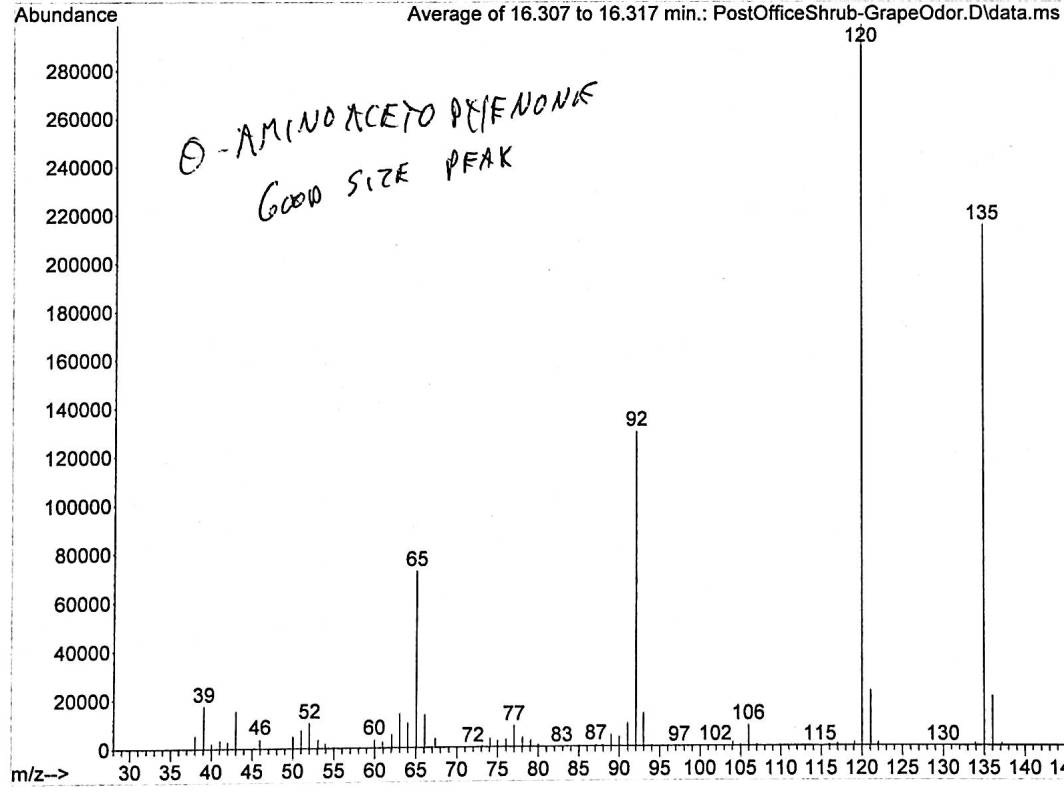
Below: The mass spectrum of the o-aminoacetophenone peak at 16.3 minutes. (C8H9NO, molecular weight 135)
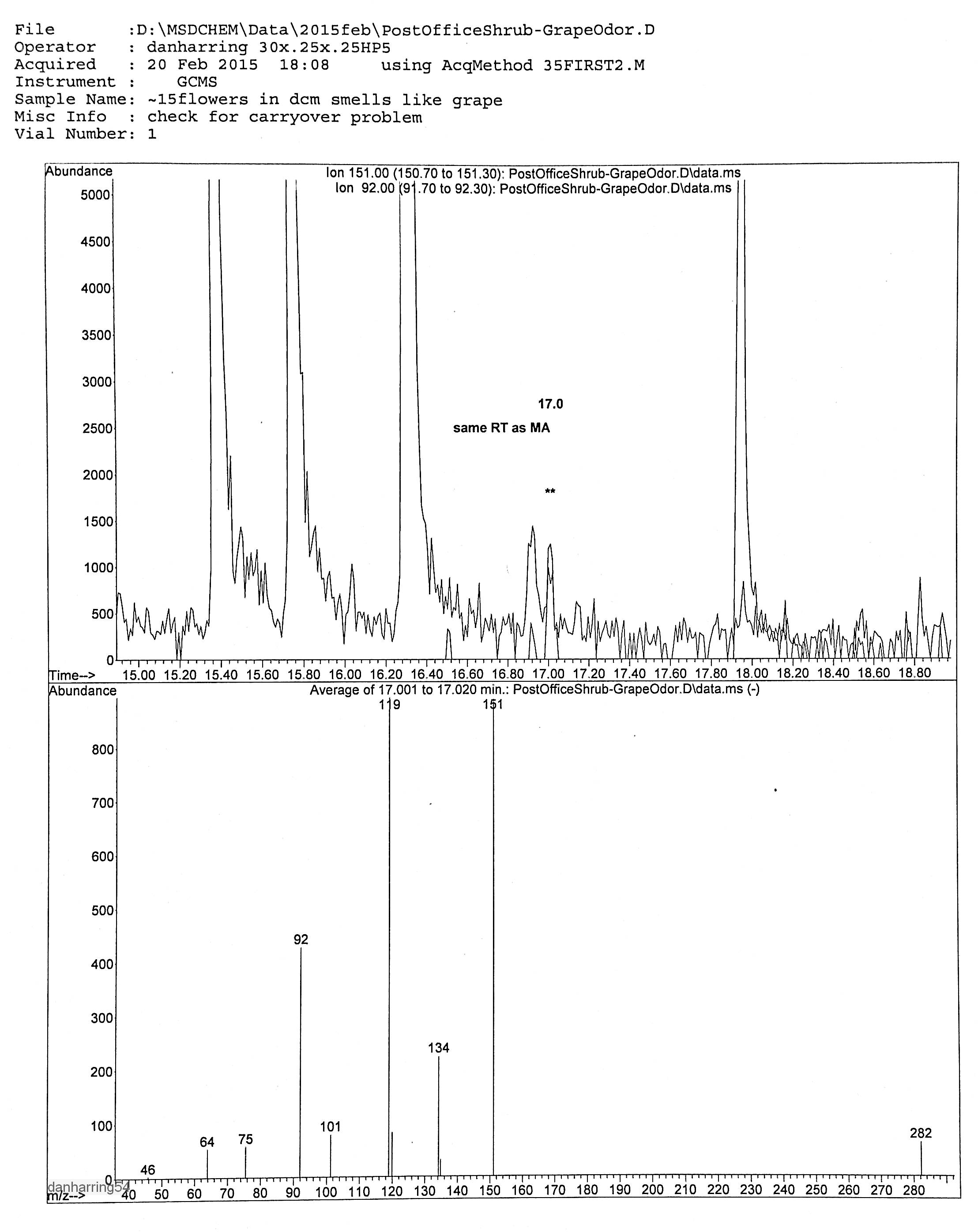
There was only a small peak for Methyl anthranilate at its expected retention time 17.0 min (marked with 2 asterisks)
Two interesting looking unidentified compounds eluted right after the sesquiterpene farnesene. The closest spectrum matches look like they’re in the anthranilate family, The 1st at 19.9 appears to be C9H9NO2. The 2nd at 21.0 appears to be C9H9NO (although it’s unusual for the smaller molecule to elute later). Below is the closest spectral match in the Wiley/NIST library.
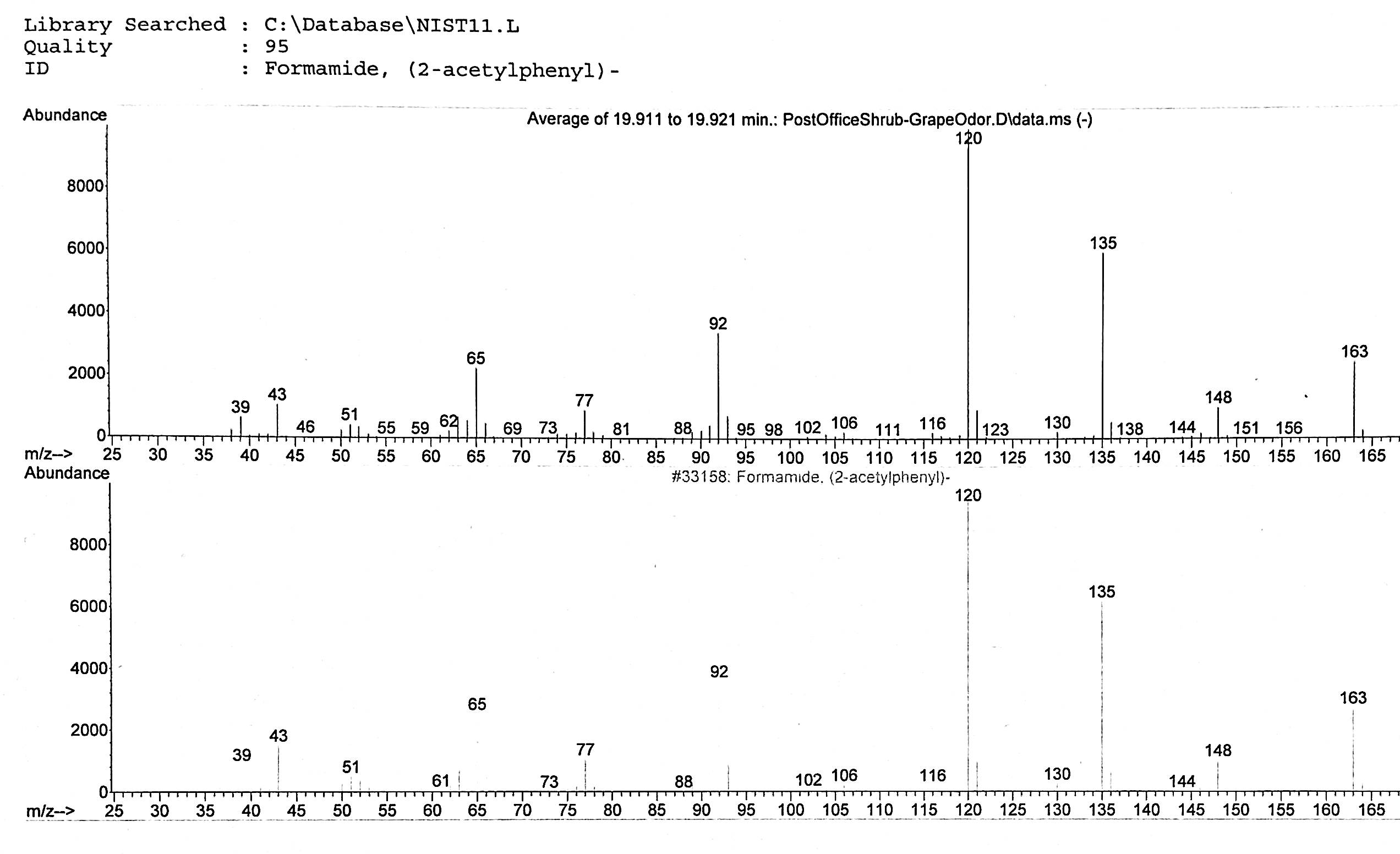
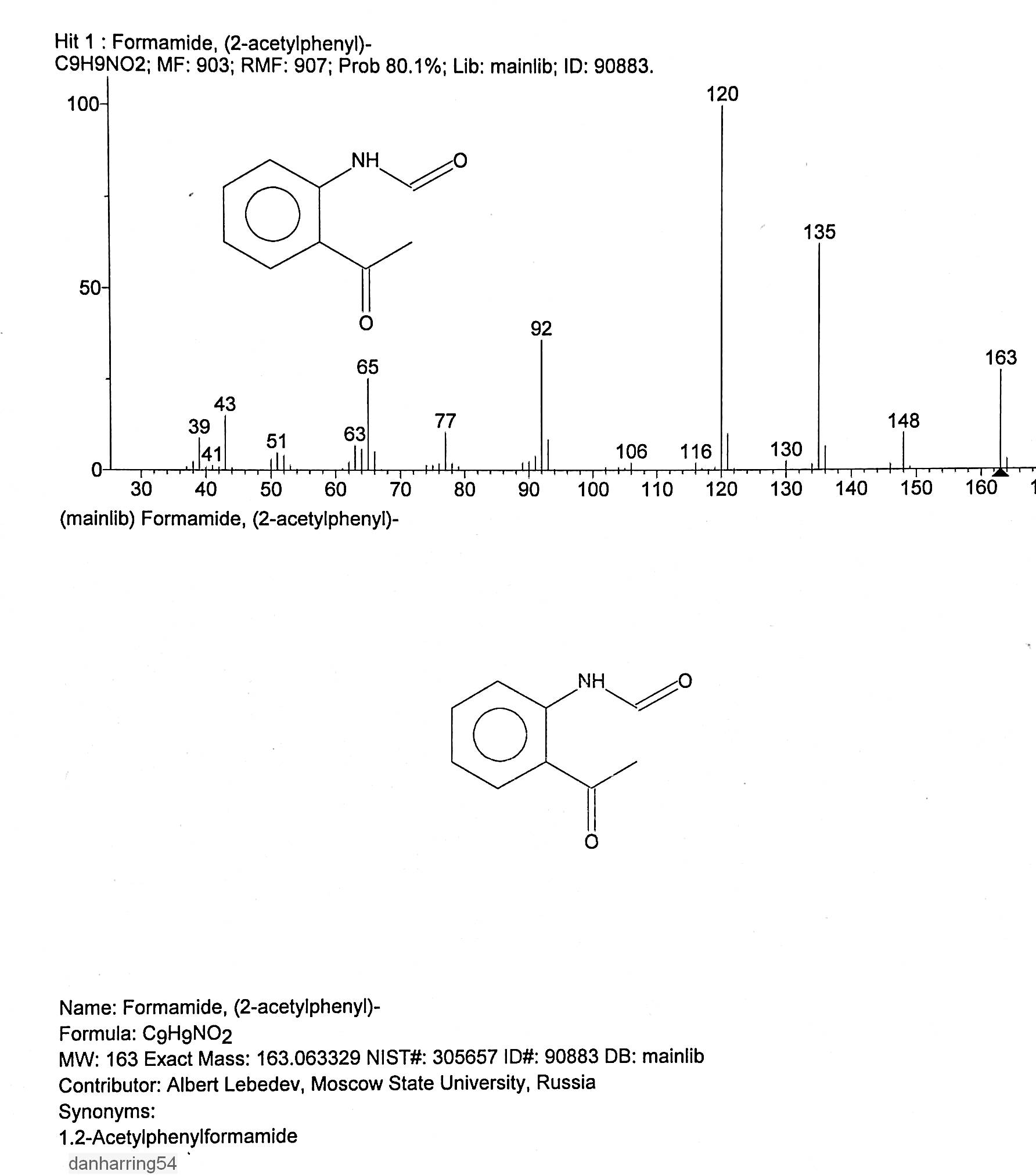
I ran analysis on the flowers 2 consecutive years (2014 & 2015) right before I retired (notice the run time started 6:08 pm on this one, after the day’s work was done…a labor of love). A few years later when I visited, the shrub had been removed. I’m going to dig thru my old files to find a more fully labelled chromatogram from the previous year.
============================================
 Dan Harring (54)